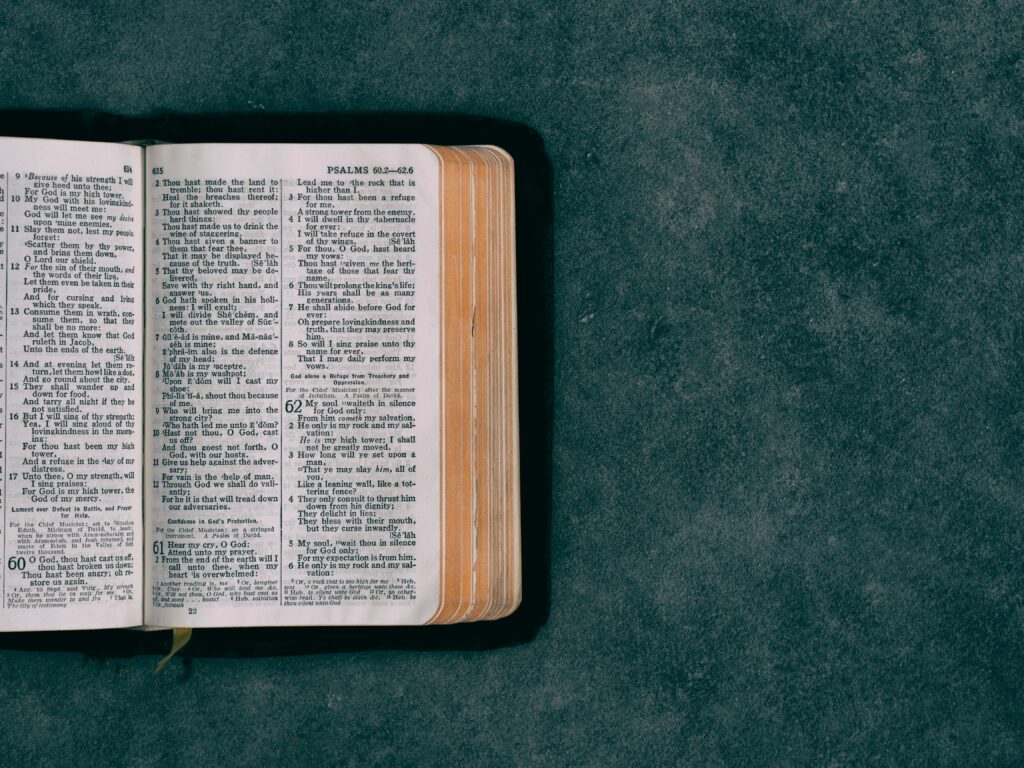
Have you ever tried to make or break a habit just by reading or listening to information? Have you been able to change a habit just by knowing something was the right thing to do? In my experience, it doesn’t usually work very well. We often struggle to do what we want to do, and instead we do what we know we shouldn’t do. Paul talked about this in his own life in Rom. 7:15 when he said, “I do not understand what I do. For what I want to do I do not do, but what I hate I do.” What we know from this is that knowledge doesn’t necessarily translate into action; our heads don’t always direct our hearts. And yet we live our lives—and read the Bible—as if this were the case, as if all we need is a little more information to live the Christian life more fully and joyfully. We’re really good at learning information, but changing our behavior is hard. Our connection to God’s Word needs more than just intellectual understanding; it also requires the engagement of our hearts.
My thesis is that we need to enjoy Scripture. Understanding what we read can be enjoyable. And sometimes, to truly understand something, we first need to enjoy it. In what follows, I will draw heavily on an excellent book I recently read for inspiration: Enjoying the Bible: Literary Approaches to Loving the Scriptures by Matthew Mullins.
Scripture is more than an instruction manual
We usually know the right thing to do, but head knowledge doesn’t always direct our hearts. And even though we know that, we often read the Bible as if it were an instruction manual for our minds, seeking only the main idea to apply. To be fair, there are many things we can learn from the Bible that way. However, the problem arises when this becomes our only way of reading everything in the Bible. When we assume that understanding every text means grasping its ideas and applying them in simple ways, we risk missing how much of Scripture is also meant to move our hearts. We miss how important our hearts are in trying to change our actions.
In looking beyond instructions, we don’t abandon the Bible’s truth or instruction. Paul tells Timothy in 2 Tim. 3:16 that “All Scripture is God-breathed and is useful for teaching, rebuking, correcting and training in righteousness.” We need to broaden our understanding of what instruction means. It’s not just about learning a lesson with our minds. Paul said to Timothy, “All Scripture.” That means everything, including the things that seem harder to understand.
And some parts of the Bible aren’t direct and straightforward. In the Bible, God chose various artistic forms—poetry, proverbs, parables, stories—to communicate. These forms aim to capture our imaginations and move our hearts, leading to a deeper, more transformative understanding.
Paul talks about our hearts and minds in Colossians 3:1-2:
Since, then, you have been raised with Christ, set your hearts on things above, where Christ is, seated at the right hand of God. Set your minds on things above, not on earthly things. For you died, and your life is now hidden with Christ in God.
In Greek, “set your hearts on” comes from a word that means “seek, look for, desire.” When Paul says “set your minds on,” that comes from a word that means “to think.” The Bible Knowledge Commentary notes that “The first suggests striving; the second suggests concentrating.” To view the Bible as only an instruction manual for our minds risks missing how it also aims to instruct our hearts and desires. But what does that look like?
I find myself repeatedly drawn to Psalm 119. It is entirely dedicated to God’s Word, from beginning to end. It is filled with a rich tapestry of themes—themes that appear repeatedly throughout the psalm. And what was so striking was how many of these themes about God’s Word weren’t just about intellectual understanding. Many of them clearly addressed emotions and feelings. Still others pointed directly to actions in living out God’s truth. Themes include obedience, love for God’s word, remembering it, hoping in it, asking for understanding or for God to teach the psalmist, and not being shamed by the arrogant who are above God’s word, among others.
One interesting theme is delight. The psalmist took delight in God’s Word—it came up 8 times, such as in verse 47: “for I delight in your commands / because I love them.” In his commentary on the Psalms, John Goldingay defined the Hebrew word used for delight as “a child’s uninhibited, carefree playfulness.” Is this how we approach God’s Word? And if not, how can we get there?
The heart is another term that appears repeatedly in Psalm 119. The Old Testament doesn’t seem to define “heart” the way modern Western thinking does, as a separate thing from our heads. In Hebrew, it’s all one idea. The Theological Dictionary of the Old Testament says the heart “functions in all dimensions of human existence and is used as a term for all the aspects of a person.” Unlike the modern Western understanding, which associates the heart with emotions and feelings, the Old Testament Hebrew concept is bigger. It represents the center of a person’s entire being. While I continue mentioning the head and heart as different things, remember that the authors of the Old Testament didn’t think that way.
Take some time with Psalm 119. Go through it and see how it makes you feel. What images does it paint in your mind? What does it say to you through all of that? Because, as the psalm that is all about God’s Word, it’s incredibly revealing to see just how much it talks about our emotions, our feelings, and the posture of our hearts. About how we delight in Scripture. It’s not just about what we know in our heads; it’s about how God’s Word moves and transforms us from the inside out. What if we read Psalm 119 seriously? What if we root ourselves in its world and live as it says we should, and try to feel how the psalmist feels?
Form and content go together.
My second point is that form and content go together. The form of the communication matters, and it’s a real part of the message. Often, the biblical authors chose special ways to write. For instance, why did they sometimes write a poem instead of a simple statement or command? Why did Jesus speak in parables? Why is prophecy full of images and often written as poetry? This is because of something we frequently forget: form helps create meaning. What is said, and how it is said, are inseparable.
Let’s consider Paul’s outburst of praise at the end of Romans 11 (vv. 33-36). Think about everything Paul just finished teaching his readers in the first 11 chapters. There’s a lot of great information there, some deep thinking by a highly educated man. And then, at the end of all that, he says this:
33 Oh, the depth of the riches of the wisdom and knowledge of God!
How unsearchable his judgments,
and his paths beyond tracing out!
34 “Who has known the mind of the Lord?
Or who has been his counselor?”
35 “Who has ever given to God,
that God should repay them?”
36 For from him and through him and for him are all things.
To him be the glory forever! Amen.
Why a poem here? It communicates something beyond mere words—Paul is trying to get at something bigger—a sense of awe and wonder and mystery.
Or, let’s look at the paradoxes in Proverbs 26:4-5:
4 Do not answer a fool according to his folly,
or you yourself will be just like him.
5 Answer a fool according to his folly,
or he will be wise in his own eyes.
How can both be true? These proverbs aren’t meant for a single, easy answer. They’re designed to make us pause, wrestle, and reflect, engaging our imaginations—our hearts. Jesus used paradoxes, too, like in Matthew 10:39. He says, “Whoever finds their life will lose it, and whoever loses their life for my sake will find it.” These teachings encourage us to meditate on God’s ways, which are often higher and different from our own, and they take time. There’s no simple application in these passages. We like to try to separate form from content, the medium from the message. But these examples show that’s not always possible. The form of the message is part of how it communicates to us.
Rather than looking for a quick answer in the Bible every time we open it and twisting verses out of context to fit our needs, remember to also turn to the beautiful artistic parts that withhold answers, that instead encourage us to reflect on the confusing, paradoxical, and unknowable parts of life. In the case of Proverbs, is it telling me that I should answer the fool, or not? Perhaps I should meditate on these verses from Proverbs and see where God leads me in this particular circumstance.
Consider Psalm 23:
1 The Lord is my shepherd, I lack nothing.
2 He makes me lie down in green pastures,
he leads me beside quiet waters,
3 he refreshes my soul.
He guides me along the right paths
for his name’s sake.
4 Even though I walk
through the darkest valley,
I will fear no evil,
for you are with me;
your rod and your staff,
they comfort me.
5 You prepare a table before me
in the presence of my enemies.
You anoint my head with oil;
my cup overflows.
6 Surely your goodness and love will follow me
all the days of my life,
and I will dwell in the house of the Lord forever.
To fully understand Psalm 23 means more than intellectually realizing you should be comforted. It means that reading it should actually be comforting—it should make you feel comforted. There’s a big difference between knowing God is a source of comfort and being comforted by Him. The poem of Psalm 23 demonstrates that God is our comforter by literally comforting us through the act of engaging with it and enjoying it. Let’s examine three aspects of this poem that are integral to the meaning.
First, the poem in Hebrew consists of 19 lines: 9+9 (18) with one line positioned right in the middle, serving as the focus. Nine lines, then the pivotal line, “for you are with me,” and then nine more lines. Another thing: the beginning is 26 Hebrew words, and the end is 26 Hebrew words. This symmetry isn’t accidental. This is part of how Hebrew poetry works.
Second, at the beginning, we read “The Lord is my shepherd” (third person, talking about God). At the end, we read “I will dwell in the house of the LORD forever” (third person, talking about God). But in the absolute center, when the author describes walking through the “darkest valley,” he shifts to direct address, second person, talking to God: “You are with me.” This psalm is saying that we intellectually know God is with us, but it’s in our hardest times, in the deepest darkness—right there in the middle of the psalm—that we perceive God most closely and address Him directly. That’s another way the psalm moves our hearts.
Third, let’s examine the imagery. At the beginning (v. 1-3), the Lord is leading me; he’s in front of me. And then later toward the end (v. 6), goodness and mercy are pursuing me; they’re behind me. But in the middle (v. 4-5), the Lord is with me, he’s alongside me. I start to see an image of God before me, next to me, behind me—everywhere! I can’t go anywhere to escape the presence of God. So I can confidently say and feel with the psalmist: Lord, “You are with me.” This is all in the poetry, the beauty of words used in artistic ways. All these layers upon layers of beauty and artistry. The same God who was going ahead of you is the one who’s beside you and will be behind you, pursuing you with goodness and mercy all the days of your life. This is our God, always with us, all around us. We are never apart from his presence.
And when we feel, in our hearts, the kind of danger that is in the middle of this psalm, and we are walking through the darkest valley, that’s when we perceive God most closely, and speak right to him: “I will fear no evil, for you are with me.” This is different from just reading the psalm for information? I don’t just know in my head that God is with me, I feel it too, deep inside.
Understanding the Bible with our emotions might feel uncomfortable, and you might be concerned about meaning—can a scripture mean anything we want it to, based on how we feel at the moment? Do we each have our own personal truth? The short answer is no, but I believe that artistic communication (such as the Psalms) can allow for a spectrum of meaning. After all, art is often intentionally hard to pin down.
We already know, intuitively, that a given Scripture can mean different things at different times. How many times have you returned to a passage or verse and noticed something you hadn’t seen before? We often hear someone say, or maybe say ourselves, that a verse has “taken on new meaning.” Do we allow for the Spirit to speak to us?
Reflect on Psalm 23 and our examination of its meaning. Does reading this way imply that the meaning of Psalm 23 has changed, or that the way you used to read it was wrong? Or does this mean that you have changed, and maybe today, you have come to understand dimensions of the text that you didn’t understand before?
Consider how big events in life have caused us to see familiar things in new ways. For example, love. Was I wrong about what love was for all those years before I met my wife? Or, did love take on new meanings for me, in addition to the old meanings I had from my childhood, when we fell in love? My old understanding of love wasn’t wrong. I knew my parents loved me. However, my new experiences with my wife allowed me to gain a deeper understanding of the meaning of love that I hadn’t grasped before. Then we had children, so now I understand love, and a father’s love, and our heavenly Father’s love for us, in a way that has changed yet again. The meaning of love was always that big, and it was always there. It was always a range, or spectrum—over time, I’ve become a person who can understand different aspects of it.
When the psalmist expresses his contentment in Psalm 23: “The Lord is my shepherd; I lack nothing”—he is not writing about an emotion that is utterly foreign to most of us. At some point, we have all felt content. And yet the psalmist writes about it to imagine contentment anew. We read the psalm in whatever circumstance we find ourselves and experience contentment once again, or maybe for the first time, or maybe in a new way.
We hold God’s revelation in our hands, but then we too often treat the form of it as an unimportant barrier between us and the message, when that form is the very thing in which we should be delighting and a part of that message. When we separate form from message, we are left with something less than God’s Word, most importantly, but also with something difficult to enjoy.
When we talk about form, we are also talking about the arts. God’s word is beautiful and lovely and artistic. And art matters. God made this world beautiful. Alstair Gordon, in Why Art Matters, says,
Art matters because it points to the presence of God, the ultimate maker and Creator. Art matters because it reminds us of who we are, where we have come from and how the journey ends. Art matters because it abides with us through the storm; it lights a candle when night falls; it salves the soul and quickens the mind. Art matters because it asks important questions, puts grief into words and finds colour for joy and songs for lament. Art matters because it embodies ideas, causing nations to rise and dictators to fall. Art matters because beauty matters, and true beauty is the glory of God. Art matters because you matter and you are made in the image of God.
Think about how much of the Bible is written in an artistic style. All of this matters!
Read Scripture for love and joy.
Our ultimate goal in reading Scripture should be to deepen our love for God and for our neighbor. If reading the Bible doesn’t lead to a deeper understanding and greater enjoyment of scripture, then perhaps we haven’t truly grasped what we’ve read. We can learn to recognize and read these artistic texts in the Bible in a different way, designed to spark our imaginations and encourage contemplation. God is not only inviting us to study his Word to know right from wrong; God also desires a relationship with us. The Bible offers texts designed to accomplish both. The artistic, poetic, and beautiful portions of the Bible aim to capture and hold our attention. They don’t want us to look for the quick fact, reason, or answer. They want us to question, wonder, struggle, and rejoice in our efforts to know God.
First, let’s slow down. We often rush through the Bible, seeking bite-sized takeaways and practical applications. But the spirit of reading for enjoyment and love means savoring every word. And to grasp a poem like Psalm 23, we need to take our time, reading it over and over, meditating on it, internalizing it, putting ourselves into its world.
Second, let’s read like children. Jesus tells us to come to him as little children. Stories enchant them, and they don’t immediately try to reduce stories to abstract ideas or figure out the main point or the moral lesson. They simply enjoy them. And we can read kids a story over and over again, and they still love it. We’ve lost the ability to be enchanted by what we read in the Bible, to read it purely for enjoyment—to savor it. To have fun and immerse ourselves in the story, just as children do with their imaginations.
Third, remember that study and enjoyment go together. Think of it like this: Bible study is like weight training. It builds strength and deep understanding. But reading the Bible for enjoyment is like eating: it’s a pleasure. We eat to live, yes, but we also want to eat good food! We want to delight in the meal. And when we eat well, we’re in a better position to train at the gym and get stronger. And also, it works the other way around. When we train hard, it makes us hungry for more food. In the same way we need to exercise and eat, we need both study and enjoyment to grow spiritually and truly love God’s Word.
Engaging with the artistic aspects of Scripture, such as Psalm 23, instructs us not only through quick ideas and applications but also by reorienting our perspective. It fosters a deep trust in God and draws us into a more loving relationship with His Word and with Him.
Conclusion
God uses the beauty of his word and artistic forms to express Himself and draw us into deeper communion. God’s Word is beautiful, and its beauty is meant to be enjoyed. This enjoyment isn’t a distraction from some core truths hidden behind a confusing form; God isn’t trying to keep it all a secret. Instead, it’s a pathway to a relationship with our Creator, to a deeper understanding, and to love. The artistic elements of scripture point to God’s presence and remind us who we are.
Learn to read the Bible as a work of art. Let its beauty captivate you and draw you closer to God. In John 14:21, Jesus said,
“Whoever has my commands and keeps them is the one who loves me. The one who loves me will be loved by my Father, and I too will love them and show myself to them.”
The more we love God’s Word, the more we’ll keep it. Being rooted in Scripture in this way—in a deep love for God’s Word and an enjoyment of experiencing it—draws us back again and again, transforming not just what we know, but who we are.
Leave a Reply